
About the Project
Music theory usually gives you the what — scales, chords, key signatures — and leaves the why to your ear.
The Chromatic Block System starts from a different question: what if the whole chromatic scale was built from one repeating shape? Take four adjacent notes, one gap note apart, all the way around the Circle of Fifths — and everything else, every scale and every chord, falls out of that one shape.
You can build it by hand in the next five seconds. No key signatures required.
From Zero to Hero
Section titled “From Zero to Hero”Start with the black keys. The F♯ major pentatonic scale is just the five black keys on a piano — forgiving, hard to play wrong, and something most people can noodle on immediately without thinking about theory at all.
Find its relative minor. Every major pentatonic has a relative minor pentatonic hiding inside the same five notes — for F♯ major pentatonic, that’s E♭ minor pentatonic, three semitone below. Same keys, different center of gravity. This five-note shape becomes the skeleton of everything that follows.
Add four passing notes. Two adjacent white keys on the left, E and F, and the two adjacent white keys on the right, B and C, relative to the center of the skeleton. That’s it — you’ve just built the nine-note nonatonic scale in the key of F♯, by ear and by hand, without counting a single interval.
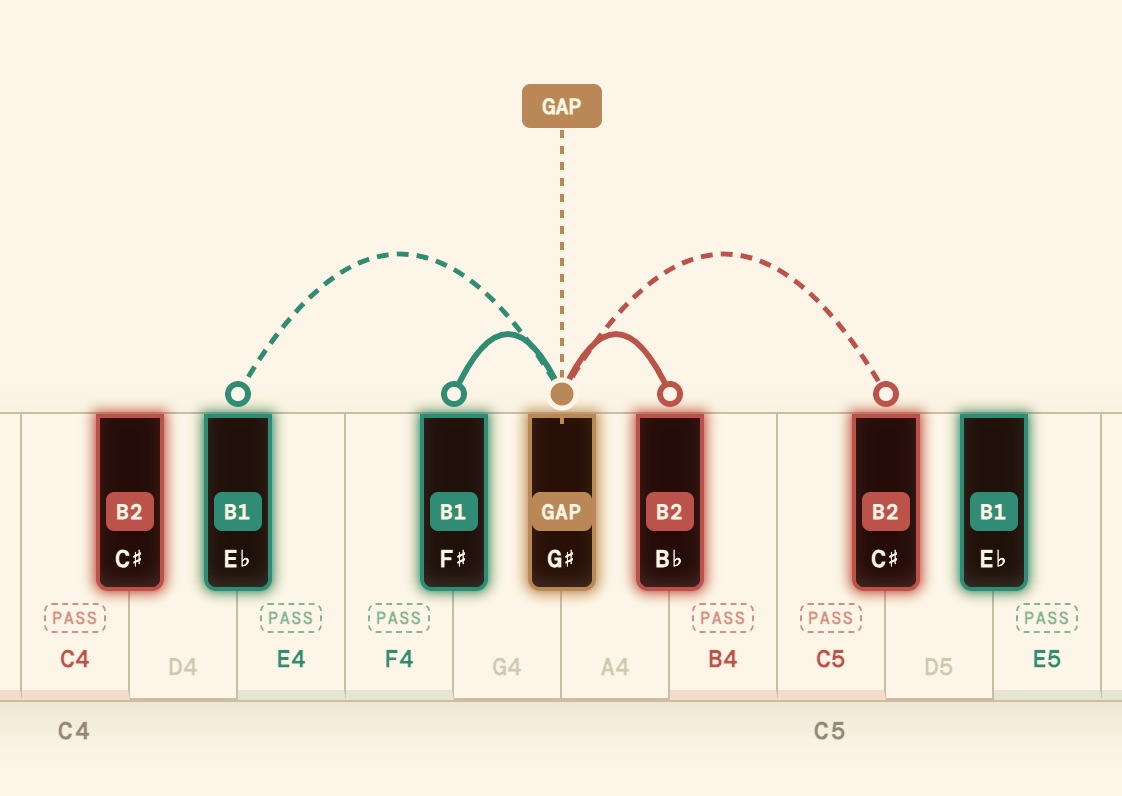
The same shortcut works in any key. The F nonatonic scale — the example used throughout the rest of the paper — is built the same way: start from D minor pentatonic, the relative minor of F major pentatonic, add E♭ and E on the left, B♭ and B on the right, and G falls into place as the note in the middle, the gap note that holds the whole shape together.
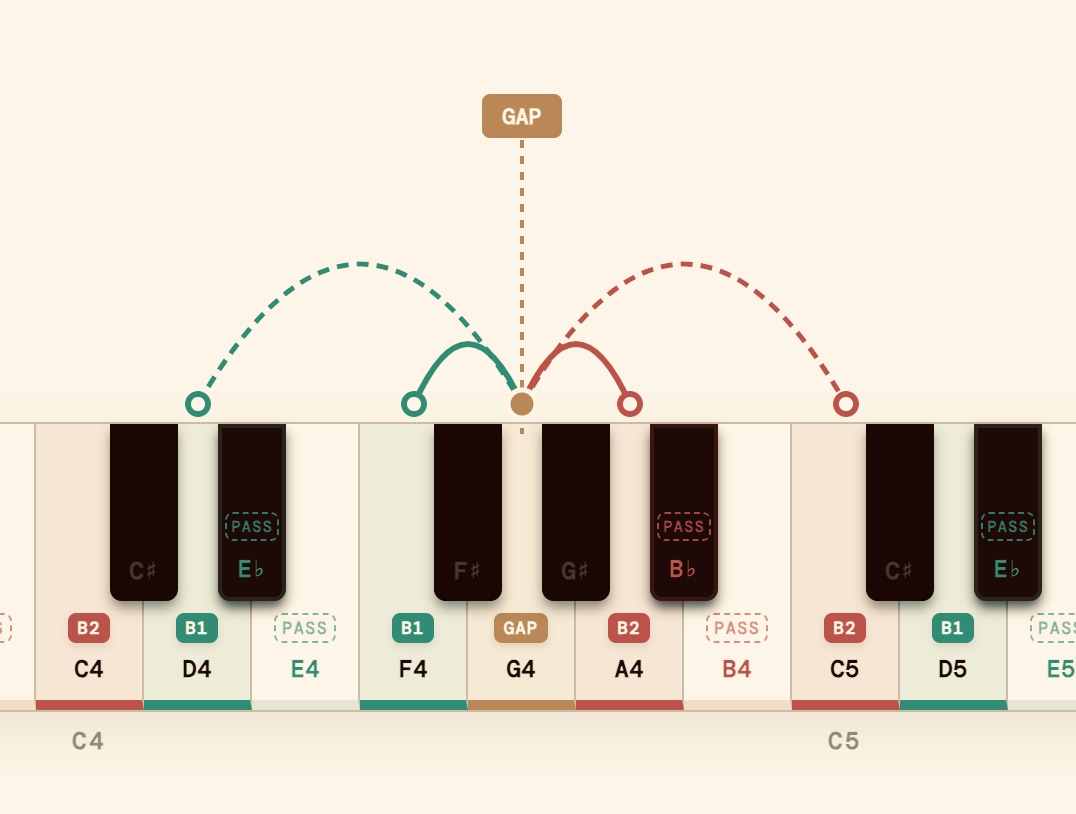
- Starting with your D minor pentatonic skeleton and adding those two inner passing notes (E and ) fills in the gaps to form the complete 7-note diatonic set (). This gives you the full key set for both major and its relative minor, achieved purely through geometric shape completion rather than traditional interval counting or memorizing key signatures.
- Similarly, starting with your D minor pentatonic skeleton and adding just those two edge passing notes (E♭ and B) fills in the gaps to form the complete C melodic minor scale.
Pentatonic structures are used as a GPS position to express all legacy triads in all of their inversions. For example, selecting a root major triad inversion and playing it through an underlying pentatonic structure yields five major triads.
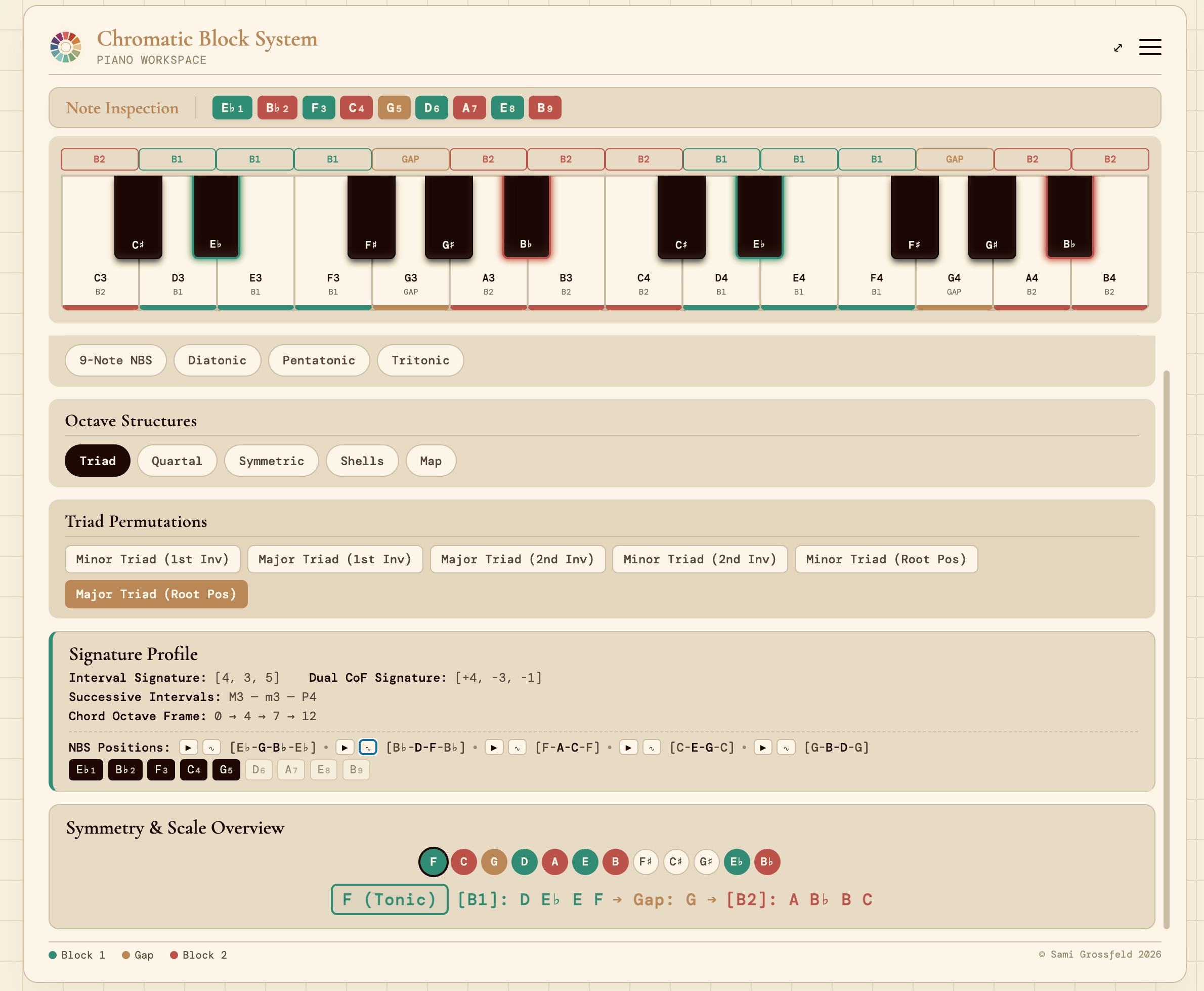
This footprint offers a compact way to gather all major triads into one space, bypassing traditional Roman numeral conventions. Furthermore, nonatonic scale hosts five major triads compared to the three in the legacy major scale—achieving more with less.
The major triad is not just an easy mnemonic rule; it works equally well for minor triads. There are a total of thirty triad inversions in the nonatonic space compared to eighteen in the diatonic space, expressed by only five simple pentatonic structures.
To reiterate, this applies only to triads. The other Signature families have their own unique footprints and characteristics.
How it works
Section titled “How it works”Instead of thinking in scales and key signatures, this framework thinks in positions on the Circle of Fifths — coordinates, not calculations. Picture it like a GPS: your position is where you are on the chain of fifths, and your signature is a compass telling you which directions you’re allowed to move from there while staying in key.
Certain positions on the Circle of Fifths already have familiar shapes attached to them — a major pentatonic, a diatonic scale — and those shapes act as footprints: a set of notes you can use as launch points for a signature, letting you move through the chromatic space while always landing back inside the key.
The useful part: footprints from different keys overlap. Where they overlap, you can pivot from one signature to another without ever leaving the note you’re standing on — switching the underlying structure without switching what you’re playing. That’s the mechanism behind everything from modal color shifts to reharmonization in the full paper.
None of this replaces your ear. Scales, in this framework, are a way to catalog what you’ve found — not a checklist you memorize before you’re allowed to play.
This page is the preview. The full paper works out the complete formal system behind it — every block, every gap note, every triad signature, every mode, derived and checked from first principles.
Signature Map
Section titled “Signature Map”The Signature Map provides a snapshot of the interval signature. The first table is the basic version, while the following variations are infographics designed to offer a different views. It can be used as a universal lead sheet.
The Piano Workspace
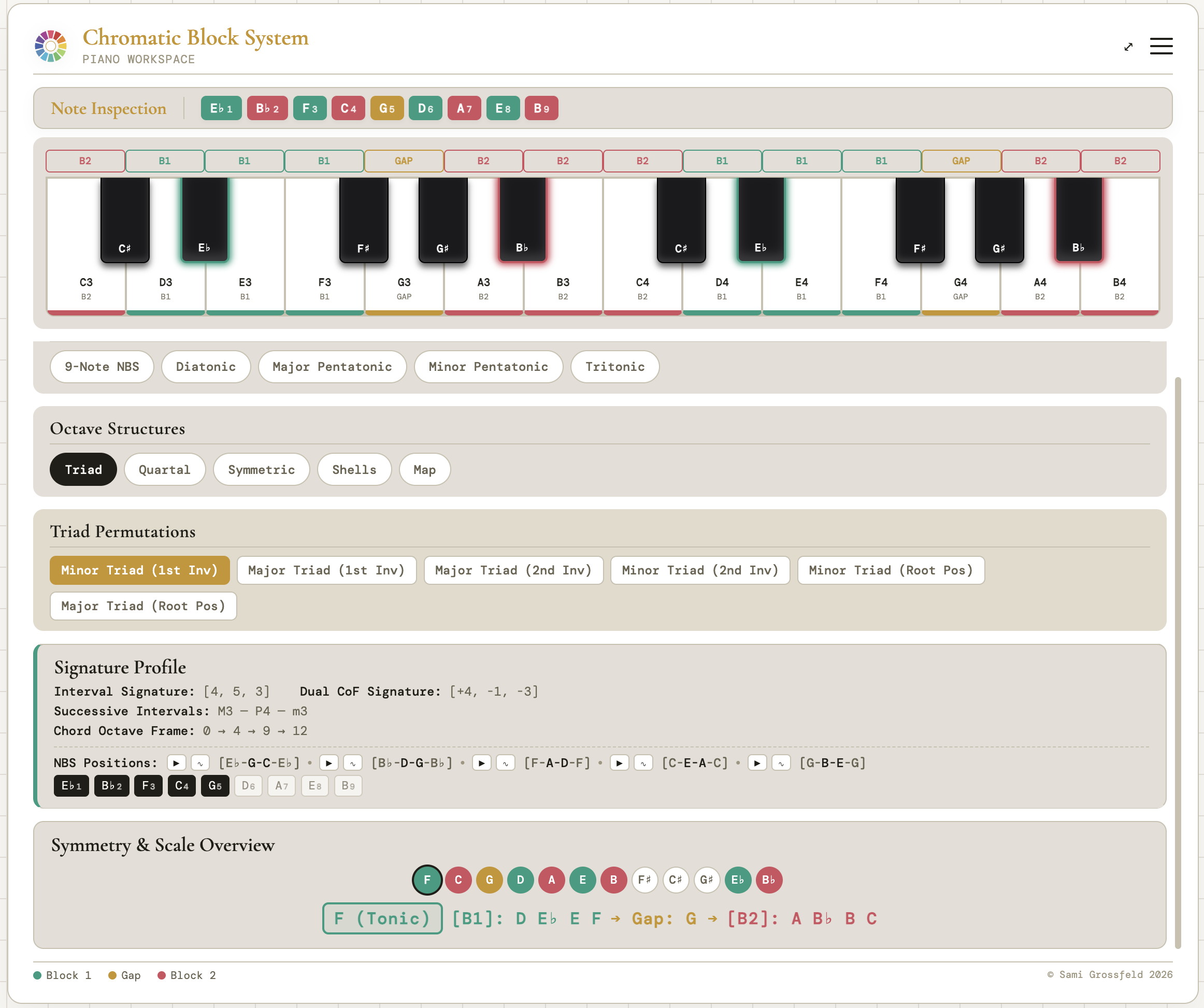
Section titled “The Piano Workspace”The Workspace provides a visual exploration of the concepts and structures discussed in the paper. It compiles all signature interval mappings and enables interactive inspection of their application on the keyboard. As a web-based app, the Workspace requires no downloads and is fully rendered in the browser.
Becoming
Section titled “Becoming”I was fooling around with the F Lydian mode (all white keys in the key of C major). I tried playing a quartal chord (perfect 4th - perfect 4th - major 2nd) through the Lydian scale. The chord moved out of key at the tonic F and at C; with F as the bass, E-flat and B-flat were introduced, and with C as the bass, B-flat was introduced. Arpeggiating this chord through F Lydian sounded nice to me, and I wondered why I should limit myself to the scale’s diatonic 7 standard notes and give up the tonic F and C.
When I gathered all the notes—the F Lydian scale plus the two borrowed notes, E-flat and B-flat—a symmetric layout of a chromatic block system revealed itself. While this looked elegant on the keyboard, I was initially reluctant to deal with another scale, as the diatonic world is overwhelming enough. It looked very uninspiring scale, two blocks of four chromatic note, and playing it step wise was not easy and did not sound interesting.
However, I realized that the two added notes were a perfect fourth/fifth apart, and B-flat was a perfect fourth from the tonic F. Looking at the circle of fifths, I knew that diatonic scales capture a continuous 7-note arc. By adding these two extra notes, a continuous 9-note arc revealed itself. This suggested that a 9-note scale (a nonatonic scale) might be a logical evolutionary step—a missing link between diatonic and chromatic space.
While exploring the properties of this scale, I discovered the dominance of the gap note and realized the scale merges three diatonic scales: Mixolydian, Major, and Lydian. Playing the inversions of a quartal chord through these scales revealed the same 9-note scale.
When looking into the legacy triads within this scale, pentatonic structures emerged as pathways to play through the 345 chords. These embedded structures are much easier to internalize and play, and can be used to express the 9-note scale, where the scale itself is just a theoretical formalization and a distractor during improvisation.
I can now play within the scale intuitively, similar to playing only the black keys, but with nine keys where no key is privileged. There are no hard or easy keys; the signature map is my universal lead sheet, my GPS navigation system. I care no more about scales, esoteric chord names, Roman numerals, key signatures, sharpening the fourth, semitone counting, or jargon like “subdominant” or “supertonic.” These classes of signatures are all that is needed to explore, restoring the intuitive nature of playing only black keys but with far more possibilities.
“In music there is always more.” (Jon Batiste)
About the Author
Section titled “About the Author”Sami Grossfeld
“I reduce myself to anonymous point so as not to disturb the higher spheres.” (Abraham Chalfi)
Licensing & Copyright
Section titled “Licensing & Copyright”The theoretical framework, manuscript, and associated application software are copyright © Sami Grossfeld 2026.
To protect the integrity of the theoretical framework while allowing for community exploration, the project is licensed as follows:
- The Manuscript & Theory: Provided under the Creative Commons Attribution-NonCommercial-NoDerivatives 4.0 International (CC BY-NC-ND 4.0) license. You are free to share and copy the material, provided appropriate credit is given.
- Chromatic Block System — Piano Workspace: The source code for the interactive browser application is provided under the MIT License, allowing for open academic and developer inspection.
Connect
Section titled “Connect”Whether you have questions, feedback on the workspace UI, or thoughts on the formal manuscript, your input is welcome.